Wednesday, September 07, 2005

I never sang for my father

The boy's got a voice
But the voice is his natural disguise
Yes the boy's got a voice
But the words don't connect to his eyes
He says "Ah, but when I sing
I can hear the truth auditioning"
The boy's got a voice
But the voice is his natural -
["Oh, Marion," by Paul Simon]
The first thing to know is that I love to sing. I do. But few people have ever heard me do it, even though people tell me I do it rather well. Even some long-time friends, now drifted away over the years, heard me rarely if at all. I just shy away from singing in public.

It's not stage fright, lordy no. I've been known to rattle a few windows in the course of giving a speech and I was always willing to be the one to appear on some TV segment or another at places where I worked. No, it's not that.

It's more that I'm uncomfortable with displaying emotion publicly. Intellectual passion, yes - which I why the window-rattling I mentioned was not a problem - but emotion, what moves the heart rather than the conscience, no. "But when I sing, I can hear the truth auditioning" - or, as I put it to someone once, singing is the closest this particular atheist gets to praying. When I sing, my heart is on the line and I know that those with eyes to see may see more than I would care to show.

So I'm uncomfortable singing in public. But now I wish I could stand in the street and sing out, sing to any and all passing strangers, sing a song for Katrina. Because I can't find way to express it in words.

I have been trying for over a week to write something about Katrina. But every time I try to write, I'm stymied not only by the magnitude of the event but even more by the fact that every time I start, I come across some new outrage, some new fact or revelation that points out in ever-sharper relief the devastation, the pain - the appallingly unnecessary pain - the loss, the murderous indifference of those who were warned, who were told in so many words that this could happen but who ignored it because, why, because it wasn't politically useful? Because the people at risk were poor and black and so no one cared?

It certainly wasn't because of the cost: The Army Corps of Engineers had requested $27 million for the current fiscal year to pay for hurricane-protection projects around Lake Pontchartrain. The doesn't seem like a large amount for a government that is blasting away at Iraq and Iraqis to the tune of $6 billion a month, especially when
[b]efore 9/11 the Federal Emergency Management Agency listed the three most likely catastrophic disasters facing America: a terrorist attack on New York, a major earthquake in San Francisco and a hurricane strike on New Orleans. "The New Orleans hurricane scenario," The Houston Chronicle wrote in December 2001, "may be the deadliest of all."
Even so, precisely because of war costs, the corps got only $5.7 million - and that was nearly 50% more than the Shrub team wanted to give them. The result was
the corps delayed seven contracts that included enlarging the levees, according to corps documents.
And that was after a year during which a
New Orleans Times-Picayune article noted: "For the first time in 37 years, federal budget cuts have all but stopped major work on the New Orleans area's east bank hurricane levees." The article quoted the manager of the Army Corps of Engineers' Lake Pontchartrain levee project saying that "people should know that this is a work in progress, and there's more important work yet to do before there is a complete system in place."
They knew, they knew, they knew that the hurricane protection around New Orleans was inadequate. They knew for years. They knew New Orleans was a disaster waiting to happen.
[E]ngineers say the levees preventing this below-sea-level city from being turned into a swamp were built to withstand only Category 3 hurricanes. And officials have warned for years that a Category 4 could cause the levees to fail. ...

"We certainly understood the potential impact of a Category 4 or 5 hurricane" on New Orleans, Lt. General Carl Strock, chief of engineers for the U.S. Army Corps of Engineers, said Thursday, Cox News Service reported.

Reuters reported that in 2004, more than 40 state, local and volunteer organizations practiced a scenario in which a massive hurricane struck and levees were breached, allowing water to flood New Orleans. Under the simulation, called "Hurricane Pam," the officials "had to deal with an imaginary storm that destroyed more than half a million buildings in New Orleans and forced the evacuation of a million residents," the Reuters report said. ...

[O]n Sunday[, the day before Katrina hit,] Placquemines Parish Sheriff Jeff Hingle referred back to Hurricane Betsy - a Category 2 hurricane that struck in 1965 - and said, "After Betsy these levees were designed for a Category 3."

He added, "These levees will not hold the water back."
And then they, despite knowing, despite have studied the possibility, watched and did nothing as a Category 5 hurricane headed for the city. (Katrina weakened to a Category 4 before making landfall.)

And let me be clear here: The "they" in question are Homeland Security and FEMA. State and local officials could perhaps have done more or done sooner but they knew going in they had no chance, that they were going to be overwhelmed.
City, state and federal emergency officials[, reported the July 24 New Orleans Times Picayune,] are preparing to give the poorest of New Orleans' poor a historically blunt message: In the event of a major hurricane, you're on your own." ...

In an interview at the opening of this year's hurricane season, New Orleans Emergency Preparedness Director Joseph Matthews acknowledged that the city is overmatched.

"It's important to emphasize that we just don't have the resources to take everybody out," he said in a interview in late May.
An estimated 134,000 people were without transportation to evacuate the city and the officials openly admitted they simply did not have the ability to get them out. And they asked for help. Louisiana Governor Kathleen Blanco declared a state of emergency on August 26 and made a formal request for federal aid on August 28, the day before the storm hit. The outrageous White House lie that everything bad that happened was because she supposedly was sluggish in asking for federal help is easily derailed: The state government's website has a copy of the letter at this link in .pdf format. (In fact, it was so outrageous that the Washington Post, which reported the assertion from an unnamed "senior White House official," had to issue a correction within a few hours.)

Oh yes, the lies. The lies. The lies while people drowned. The lies while people went without food and water for days. The lies while people sweltered, suffered, begged, waited, while they suffered and begged some more, while they moved the stinking corpses into stairwells at the convention center or left them on the street because there was nowhere to put them, while the smell, the stench, the sickness, the strain, the violence climbed around them. Oh, the lies.

The feds whined that they couldn't get into the city, couldn't get there to get people out or supplies in, even as TV news crews with their trucks got to and from the Superdome and convention center. As late as Thursday, Department of the Security of the Fatherland Secretary Michael Chertoff dismissed as "rumor" the suffering at the convention center while claiming "we are getting food and water to areas where people are staging." As late as Friday, FEMA director Michael Brown was saying that they learned about the desperate conditions at the convention center just the day before - and that though broadcast news reports. And he was still denying reports of uncollected corpses and violence! Even worse, he declared that "We've provided food to the people at the Convention Center so that they've gotten at least one, if not two meals, every single day."

"Lies," the Times-Picayune replied, "don't get more bald-faced than that."

And security? No problem, Brown claimed with a straight face.
I actually think the security is pretty darn good. There's some really bad people out there that are causing some problems, and it seems to me that every time a bad person wants to scream of cause a problem, there's somebody there with a camera to stick it in their face.
That is, we're just a terrific agency doing a terrific job and everything is terrific and anything you think to the contrary is all the media's fault.

Bush, of course, had to get in on the act; he couldn't let his aides have all the fun of making up crap. So he told "Good Morning America" in an interview Thursday that "I don't think anyone anticipated the breach of the levees." Just like no one anticipated airliners being used as weapons. That was such a whopper that it was being spun by the next day, when Brown was claiming the real thing that nobody anticipated was that the breaks would be so big and cause "such widespread devastation" - this, again, even though an exercise run just a little over a year before ("Hurricane Pam") was about exactly that prospect.

And since Brown appears to get his information from news reports rather than his own agency, maybe he saw this from AP from last May:
Officials have warned that if a major hurricane hits New Orleans, thousands of people could be killed and the city could be flooded for weeks as flood waters breach the levees ringing the city, which has the topography of a saucer that dips several feet below sea level in many places.
Lies. All lies. Or let me be clear: I hope they are lies, I hope they are just efforts at CYA and damage control to cover up their incompetence. Because if they aren't, they reflect stupidity and an indifference to human life to a degree that is truly frightening. I cling to the hope of simple lies. But it's a hope hard to maintain.

Because they knew what was coming. They had to know. Or are we really supposed to believe Chertoff when he claimed that it wasn't until just a day before landfall that they knew it was a Category 4 storm heading for New Orleans when the National Hurricane Center had predicted exactly that as early as the Friday before? What should I hope for? That they were simply that incompetent and now are just too chicken to admit how massively, ruinously, they screwed up? What's the alternative, that they simply didn't care if thousands died and acted only when the political fallout looked unpleasant? What does it say about their performance when you have to hope for incompetence and lies as a preferable explanation?

Did they care? Did they care at all? I mean about the people, not the politics. If you think they did, how could you tell? What sign could you use? Who in the administration showed a flicker of concern? Shrub, sharing a birthday cake with John McCain? Defense Secretary Donald Rumplestiltskin going to a baseball game? Secretary of State Can'tbe Right - who, when asked about accusations that the government responded slowly because many of the victims were black, said "How can that be the case?" - doing her Imelda Marcos imitation? Who?

FEMA, supposed to be the boots on the ground, sat on its collective ass for days even though Bush had issued a declaration of an emergency that gave it the authority to act. Then when it did move, it made things worse.

For one thing, it all but ignored an offer of large-scale relief assistance from the city of Chicago: Mayor Richard Daley offered to send more than 400 police, fire, and medical personnel along with dozens of trucks and two boats - and they would bring their own food, water, and supplies. FEMA accepted one truck. Period.
Daley wasn't the only generous donor to be rebuffed. Throughout last week, various local and state governments, corporations and nonprofit organizations across the nation attempted to help in the relief effort, only to be snubbed by federal officials.... [T]he Department of Homeland Security barred the American Red Cross from entering New Orleans with food. Five hundred Floridian airboaters were ready to rescue people stranded in inundated homes, but FEMA turned them down. Twenty sheriff's deputies from Loudoun County, Va., suffered a similar fate.
And if you haven't seen the video of Jefferson parish president Aaron Broussard's appearance on Meet the Press, follow the link and do it now. If it doesn't break your heart, you don't have one.
We have been abandoned by our own country. Hurricane Katrina will go down in history as one of the worst storms ever to hit an American coast. But the aftermath of Hurricane Katrina will go down as one of the worst abandonments of Americans on American soil ever in U.S. history. ... Bureaucracy has committed murder here in the greater New Orleans area and bureaucracy has to stand trial before Congress now. ...

We had Wal-Mart deliver three trucks of water. FEMA turned them back. They said we didn't need them. This was a week ago. FEMA, we had 1,000 gallons of diesel fuel on a Coast Guard vessel docked in my parish. When we got there with our trucks, FEMA says don't give you the fuel. Yesterday - yesterday - FEMA comes in and cuts all of our emergency communication lines. They cut them without notice. Our sheriff, Harry Lee, goes back in, he reconnects the line. He posts armed guards and said no one is getting near these lines.
The only thing FEMA did well, it seems, was PR: Last Thursday, the New York Times carried a puff piece that had to be little more than a re-written FEMA press release on how all the great ways the agency supposedly has been improved "since 2001 to better prepare the nation for a possible terrorist attack was helping in this catastrophe as well," an article that sloshed together a bunch of numbers of this many thises and that many thats as if how many "logistics centers" the outfit has is the proper measure of success instead of how much materiel and personnel it could put on the ground in how short a time.
"This is an exam for everything we have done since 9/11," said James Jay Carafano, an expert on domestic security and a senior fellow at the Heritage Foundation, a conservative research organization.
It was, indeed - and FEMA, Security of the Fatherland, and all of the rest right up to the Shrub-in-Chief himself failed miserably.

Did they know? Did they care? Billmon at The Whiskey Bar took a look at how FEMA responded to Hurricanes Charley, Frances and Ivan last year as they triple-whammied Florida. Then, the agency was oh so organized and really Johnny-on-the-spot, even to the point of having pre-positioned relief supplies.
FEMA officials must have been deeply gratified to see the effect their heroic efforts had in the place where they were most desperately needed - Bush's poll numbers [in Florida as the election approached]. ...

[W]hen the chips are down, and the need is absolutely dire, this administration can still deliver the kind of coordinated emergency response that once made the U.S. government the envy of the world - just as it cooly and capably protected the Iraqi Oil Ministry from the chaos and looting that trashed every other government office in post-invasion Baghdad. As is usually the case in public service, it's just a matter of having the right incentives. ...

[S]ince I'm lucky enough to live in a swing state that is also coveted by GOP political strategists, I probably don't have to worry ... that is, as long as any future disasters around my neck of the woods happen in one of those years divisible by two.
Oh, but there I go again, being political. Intellectualizing. Dealing in anger and conscience rather than gut reaction. Because, once again, the gut reaction stays inside. The tears do not come except to be quickly suppressed. As the sewage- and lead-contaminated floodwaters of New Orleans are pushed and pumped out so achingly slowly, as the next shock looms, a shock of the thousands of rotting, bloated bodies expected to be revealed as the water level drops, as some officials are saying that the city "has completely been destroyed" and some voices have even raised the possibility of not rebuilding the city at all, of just abandoning it entirely, and as the gross, foul, disgusting, inhuman, self-serving lies of those who could have done more, who could have done better, who could have acted, who knew, who knew but who just didn't care, as their lies mount a stink greater than the fetid fumes of death that reek in the streets of New Orleans but who now want to cover their tracks by preventing media from photographing the recovery of the dead, hoping such a blackout of coverage will conceal the blackness in their souls.... As it all goes on, I just - I just wish I could sing.

Footnote: HurricaneHousing.org, a project of MoveOn, has a website for people can offer a bed for someone evacuating from New Orleans. As of tonight, they have offers of nearly 208,000 beds. Go here to offer accommodations or if you need, or someone you can refer needs, a place.

Monday, September 05, 2005

Poll-axed

Apparently blanching at the thought of being labeled "weak on security" or "defeatist," Dummycrats are scurrying around, looking for ways to criticize Shrub's "lack of leadership" on Iraq and the conduct of the war - without actually proposing any alternatives. This, they seem to think, is smart politics, as the Washington Post reported last week.
"Credit the Democrats for not trying to pour more gasoline on the fire, even if they're not particularly unified in their message," said Michael McCurry, a former Clinton White House press secretary. "Democrats could jump all over them and try to pin Bush down on it, but I'm not sure it would do anything but make things worse. The smartest thing for Democrats to do is be supportive."

And some argue that Democrats do not need to craft an alternative policy, deeming it better simply to let Bush struggle.
To the extent they have offered an alternative policy, it's been one of declaring Bush a wimp, as the Boston Globe noted earlier last month.
Even Democrats who have been associated with liberal positions on international affairs are calling for more troops in uniform, proposing that threats of force be used to stop nuclear weapons programs in Iran and North Korea, and pressing for potential military intervention to ease famine and oppression around the world.

The emerging message among Democrats reflects a recognition that winning congressional and presidential elections in the post-Sept. 11 era requires candidates to establish a willingness to use America's military might and keep the nation safe, according to party leaders and strategists.
Note here that not a single reference is being made to what's a good policy or what's right or wrong, what's actually helpful or damaging to any concept of justice; no, it's all about - overtly about - what wins elections, what's "smart."

And people say the Dims have no core values. I bet they're embarrassed now!

On the other hand, is this "smart politics?" Because of a request for information from an acquaintance, just the other day I was looking at some recent polls, which, taken together, indicate that Americans are increasingly distressed about the war in Iraq, even though they haven't yet come to a clear conclusion as to what to do about it. However, while the "stay the course" 'cause "you break it, you bought it" mentality being embraced by what passes for liberal Democrats these days (e.g., Joe Biden, Hillary Clinton, and John Kerry - although he at least can say that he was saying it a year ago) has something of a following, it's not nearly as strong as the Dums seem to think (or want to claim). "Beyond the beltway" is more ticked off about the war than the cowardly politicos of our non-opposition party seem to realize - or want to hear.

For one thing, people consistently say, in one way or another, that it would have been better if the war had never happened:
CBS News poll, August 29-31
- Looking back, do you think the United States did the right thing in taking military action against Iraq, or should the U.S. have stayed out? Should have stayed out, 49% - 45%

CNN/USA Today/Gallup poll, August 28-30
- In view of the developments since we first sent our troops to Iraq, do you think the United States made a mistake in sending troops to Iraq, or not? Mistake, 54% - 46%

ABC News/Washington Post poll, August 25-28
- All in all, considering the costs to the United States versus the benefits to the United States, do you think the war with Iraq was worth fighting, or not? Not Worth Fighting, 53% - 46%

Associated Press/Ipsos poll conducted by Ipsos-Public Affairs, August 22-24
- All in all, thinking about how things have gone in Iraq since the United States went to war there in March 2003, do you think the United States made the right decision in going to war in Iraq or made a mistake in going to war in Iraq? Mistake, 53% - 43%
What's more, they're not happy with the results so far:
CBS News poll
- Do you think the result of the war with Iraq was worth the loss of American life and other costs of attacking Iraq, or not? Not worth it, 61% - 33%

- As a result of U.S. military action against Iraq, do you think the threat of terrorism against the United States has increased, decreased, or stayed about the same? Increased, 40%; Decreased, 16%, Stayed the same, 42%

ABC/Washington Post poll
- Again thinking about the goals versus the costs of the war, so far in your opinion has there been an acceptable or unacceptable number of U.S. military casualties in Iraq? Unacceptable, 68% - 30%

- Do you think the United States is or is not making significant progress toward restoring civil order in Iraq? Is not, 50% - 48%

AP/Ipsos poll
- Has the military action in Iraq increased the threat of terrorism around the world, decreased the threat of terrorism around the world, or had no effect on the threat of terrorism? Increased, 50%; Decreased, 20%; No effect, 28%

The Harris Poll. August 9-16
- Do you think the invasion of Iraq strengthened or weakened the war on terrorism? Weakened, 48% - 44%

- Do you think the invasion of Iraq has helped to protect the United States from another terrorist attack or not? Has not, 58% - 38%

- Do you think the invasion of Iraq, and recent events in Iraq, have made the United States much more respected, somewhat more respected, somewhat less respected, or much less respected around the world? More respected, 27%; Less respected, 68% [Results not further broken down]
When the question becomes where to go from here, opinions become muddier and dissatisfaction turns into some combination of determination, fatalism, and fury. When the AP/Ipsos poll gave people the stark choice of keeping troops in Iraq "until the situation has stabilized" versus bringing them home "immediately," people went for the former by a margin of 60% - 37%. When the ABC/Washington Post poll asked essentially the same question without the word "immediately," sticking it out still was preferred by 54% - 44%. And when that same poll asked if the US should set a deadline for withdrawal (in a question which said "others say" that setting a deadline "would only encourage the anti-government insurgents"), by a margin of 59% - 39% respondents said no.

However, as is often true, a lot seems to depend on how the question is phrased. Harris asked about withdrawing but without characterizing the responses or by suggesting that certain answers were endorsements of certain arguments. The question was "Do you favor keeping a large number of U.S. troops in Iraq until there is a stable government there OR bringing most of our troops home in the next year?" In that case, "bring them home" was the big winner; the margin was 61% - 36%.

What all this adds up to, it seems to me, is that Americans want things to work out for Iraqis, hope things work out, and feel an obligation to help, but want our government to be working on ways to extricate ourselves. While they're unhappy about the casualties, what they really fear is the very real prospect of this just dragging on without accomplishing anything. Thus, they're wary of deadlines but do want the troops out relatively quickly.

That becomes more obvious when people are given more choices. For example, CBS gave people four options about what to do now: increase the number of troops in Iraq, keep the same level, decrease the number, or remove them all. The results were: Increase, 14%; Stay the same, 25%; Decrease, 26%; Remove all, 29%. When CNN/USA Today/Gallup asked essentially the same question about what to do now - and it's important to note that both questions did use the word "now" - the answers came back: More troops, 19%; Same number as now, 26%; Withdraw some of them, 27%; Withdraw all of them, 26%.

The fact that the results match as closely as they do increases confidence that they accurately reflect actual opinion, which means that a definite majority of Americans want at least some troops brought home now. And, operating under the I think entirely reasonable assumption that there is no point to calling for withdrawing some troops now except as a first step leading to subsequent withdrawals, it seems clear that the same majority wants us to get out of Iraq with the only question being over what span of time - and a significant minority is already declaring "Out Now!"

We are the majority. It's an odd feeling.

Meanwhile, the Dums, despite Bush's failings and flailings, can't seem to get much traction with their criticism sans alternative approach; in fact, Congressional Democrats in polls have ranked even lower than Shrub. Maybe they should check this result from the ABC/Washington Post poll:
Do you think Democrats in Congress have gone too far or not far enough in opposing the war in Iraq? Not far enough, 53% - 37%
There's an old saying that "you can't beat somebody with nobody." And for many people, the Dummycrats, quite legitimately, add up to one being goose egg.

Wednesday, August 31, 2005

Footnote to the preceding

Updated In dismissing the concerns about persistently high poverty rates, Kirk Johnson, a senior policy analyst at the Heritage Foundation (where else?) argued
"It's not uncommon for poverty to go up three or four years after a recession is over."
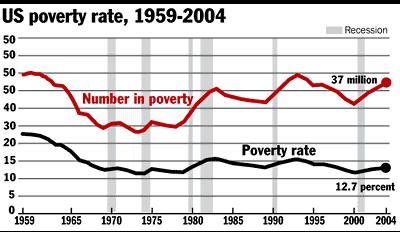
However, this graph, done by the Christian Science Monitor based on Census Bureau data, says otherwise. Note that in most cases, the increase in poverty preceded the onset of a recession and before 1990 tended to level off and start a slow drop almost immediately after the recession ended. And in no case, not even after the 1990 recession, did poverty continue to increase for four years.

We of course shouldn't be surprised, but it still should be noted that Johnson's claim is trash.

Updated to clarify the source of the graphic.

A sense of where we are

A specter is haunting the US - the specter of class warfare. The thing that "no American wants," we're told by every talking head pundit that isn't busily denying that we are a class society at all. "Social mobility," the latter intone, noting how frequently a family might, based on income, move from the upper reaches of the second-poorest fifth of the population to the bottom layer of the middle fifth or dip from the wine cellar of the richest fifth to the penthouse of the second-richest fifth, or even, for the most audacious tale-spinners among them, waxing poetic about some rags-to-riches saga, jump from the hoi polloi to the high and mighty in one go - and all maintaining with wide-eyed, well-practiced, sincerity that these are typical and altogether relevant examples of actual day-to-day experiences of American families.

But there are three truths here: First, the "class warfare" of which they speak is derided not because it is either unnecessary or inadvisable but because they fear it, fear it deeply, spend every day wondering if this will be the day it will break out. Second, that same "class warfare" would better be described as a "counter-insurgency" because third, there has been - as I'm hardly the first to note - a genuine class warfare going on for some time: a war of the haves against the have-nots, the upper-dogs against the underdogs, a war not of the rich against the poor but of the rich against the rest, and a war mostly unremarked on because those in the best position to remark on it are for the most part those who benefit by the prevailing silence.

So herewith, a few observations on how goes the battle. For the home team (that's us), things are not looking so good.
Even with a robust economy that was adding jobs last year, the number of Americans who fell into poverty rose to 37 million - up 1.1 million from 2003 - according to Census Bureau figures released Tuesday.

It marks the fourth straight increase in the government's annual poverty measure.
Nearly 6 million more Americans live in poverty than in 2000, the last year that showed a decline. Nearly a third of the poor are children. And in case anyone was wondering if this was merely an effect of overall population growth, the increase was seen in percentage as well as in numbers: 12.5% in poverty in 2003, 12.7% in 2004.

The rest of us were having our own struggles: Median household income was unchanged from 2003, which with an inflation rate of about 2% (January 2003 - January 2004) means a 2% loss in real income. And the number of people without health insurance grew from 45 million to 45.8 million last year, about 15.5% of the population. The only reason that increase was not significantly bigger was because of, according to Charles Nelson of the Census Bureau,
an "increase in government coverage, notably Medicaid and the state children's health insurance program that offset a decline in employment-based coverage."
(Some sources gripe that the number without health coverage is inflated because it includes those who were without insurance at some point during the year. The number who were without coverage for the whole year may be as many as 9 million less. Well isn't that precious and very comforting to all those struggling people who can plan in advance when they'll get sick or have a health emergency to make sure it's at a time when they have insurance which isn't limited by a pre-existing condition clause arising from a gap in coverage.)

Some analysts were apparently surprised and disturbed by all those numbers. The issue was not even so much the figures themselves, but the fact that
[t]he increase in poverty came despite strong economic growth, which helped create 2.2 million jobs last year - the best showing for the labor market since 1999. By contrast, there was only a tiny increase of 94,000 jobs in 2003 and job losses in both 2002 and 2001.
That is, relatively high poverty is persisting over time even in the face of a supposedly improving job market. We're seeing a "generation of no progress," in the words of Sheldon Danziger of the National Poverty Center at the University of Michigan, who said that
"[s]omehow, we have to confront the fact that ... a rising economy no longer lifts all boats."
The right wing, of course, is having none of it.
"America looks like a giant jobs machine still," says Douglas Besharov, director of the American Enterprise Institute's Social and Individual Responsibility Project.
That may even be true. But how important is it? What's not being addressed in the attention to the job market is that the number of jobs alone is by no means an adequate measure of economic health, nor is it by itself an indicator of opportunities to escape poverty. What kinds of jobs are being created? Are they regular, full-time? (An increasing number aren't) Do they pay enough to support a family? (An increasing number don't.) Do they have benefits, particularly health insurance? (Again, for an increasing number the answer is no.)

What's more, the actual poverty rate might be significantly higher.
Developed in the 1960s, the poverty level is determined by the amount required to feed a family. But while food has become a less important expenditure for today's families, costs for things like childcare have gone up.
Along with rent, clothing, fuel, and the like - not to mention healthcare for those increasingly constricted by state Medicaid cuts. On the other hand, just to lighten the mood for a moment, we have one of those laughable bits of corporatist inconsistency that keep cropping up where they say A here because that's useful here and B there because that's useful there, even though A and B are flatly contradictory.
Conservatives ... point out that the rate might be inflated because it doesn't include non-cash benefits like food stamps or housing assistance.
Which means they are crediting the very same kind of "wasteful, useless, inefficient" government programs they like to gripe are just "throwing money at the problem" with significantly reducing poverty below what it would otherwise be.

One "problem" the corporatists don't shy away from throwing money at is the terrible, terrible difficulty of getting and keeping good quality top executives. Even as they pompously lecture on the need to nickel and dime their employees in order to "contain costs" and so "remain competitive," they wail and moan abut how tough economic life is at the top and how what they get is a mere pittance in light of their unreachable heights of importance to the bottom line. But frankly, compared to the home team, the visitors (because they really are so separated from the rest of us that they may as well be aliens) seem to be managing to struggle through. CNN/Money for August 30 had the (for them) good news:
In 2004, the ratio of average CEO pay to the average pay of a production (i.e., non-management) worker was 431-to-1, up from 301-to-1 in 2003, according to "Executive Excess," an annual report released Tuesday by the liberal research groups United for a Fair Economy and the Institute for Policy Studies.
In 1982, at the outset of the Decade of Greed, the average CEO made "only" 42 times as much as the average worker. By 1990, that ratio had reached 107-to-1 and by 2001 had skyrocketed to a breathtaking 525-to-1 before falling back some. As one means of comparison, a military general with 20 years experience makes less than seven times what a private drawing combat pay does.

As another means of comparison, the report, available in full at this link in .pdf format,
compares the growth in average CEO pay - which was $11.8 million in 2004 - to the growth in the minimum wage. Had the minimum wage risen as fast as CEO compensation since 1990, the researchers calculated, it would now be $23.03 an hour instead of just $5.15. And the average production worker would be making $110,126 a year instead of $27,460.

In some ways, though, comparing the compensation of a company chief to the average non-management worker is a specious argument, said Nell Minow, editor of the Corporate Library, an independent investment research firm providing data on corporate governance and risk.

"I'm willing to pay people based on the value they create," said Minow....
Okay, then answer me this: We supposed to assume, at least for the sake of comparison, that a little over 20 years ago the average CEO produced 42 times more value for the company than the average worker. Are we really supposed to believe that that disparity has increased by more than 10 times in the intervening years? Are we really supposed to believe that the average CEO produces 430 times as much value as the average worker? Anybody, are we? Really?

Well, in that case, what I want to know is, just what "value" does a CEO actually produce? Seriously. What "value" does a CEO produce that is demonstrably separate from the value produced by the people on the shop floor who actually run the machines? By the people on the road who actually sell the products? By the people who take the orders, process the orders, pack the orders? Which do you think is more realistic: A business run by its employees or members (i.e., a cooperative) or a bunch of CEO's making coffee, answering phones, counseling clients, and running drill presses?

But I'm sorry, I'm being impolite. I'm even verging on - gasp! - class warfare. Better to close with Sheldon Danziger's attempt to look on the bright side. "The good news," he said, "is that poverty is a lot lower than it was in 1993." And what's more, we've discovered that your brain tumor is not inoperable: It will only require a lobotomy.

The Curse of Fengeek

There has for a long time been a dispute about the so-called "placebo effect," where a treatment with no active substances seems to have real clinical effect. As the Christian Science Monitor for Wednesday says,
[w]hen an inert placebo acts like a drug, is it just a psychological illusion? Or is it a real biological effect? ...

The effect has been demonstrated often enough to show that some patients appear to benefit from such belief. But there hasn't been enough evidence to convince skeptics that anything more than the so-called power of suggestion is at work.
But, the article immediately adds, "That's changing."
Research reported last week suggests that it's both [illusion and effect]. The mere belief that they had received a pain killer was enough to release the brain's natural painkilling endorphins in the patients tested, scientists say. ...

"The findings of this study are counter to the common thought that the placebo effect is purely psychological due to suggestion and that it does not represent a real physical change." says University of Michigan neuroscientist Jon-Kar Zubieta. He is principal author of the study published Aug. 24 in The Journal of Neuroscience.
Previous research had looked at brain scans to see how activity changed in parts of the brain that register pain in patients that experienced relief from placebos. Those trials found a connection, but skeptics dismissed it on the grounds that it could be coincidence unrelated to mental state.

However, the new showing that the patients' sense of relief coincided with the release of pain-reducing chemicals in the brain is much stronger evidence that, as the researchers said,
while pain does have "sensory components," it is "a psychologically constructed experience"
that can be affected by our expectations.

There are, indeed, some ways in which belief can make it so.

Just a warning...

...that posting might be even a little spottier than it has been the past couple of weeks. We finally had to give in and give up on an apartment with a landlord who's been good to us and upstairs neighbors we like in a city we've grown rather fond of (with a peace & justice movement we were just starting to connect to) - all because the cost of gasoline to get to and from work was eating up a good hunk of my earnings.

With the cost of a gallon of gas at the neighborhood station shooting up 57¢ in one go this week, the decision to move significantly closer to work (from about 35 miles each way to about two) proved to be a good one, if unfortunately coming a little later than it should have.

The point here is that this will be no leisurely move, it's going to be really hectic over the next month. Something will have to suffer and since neither packing nor work can be sacrificed, I'm afraid blogging will be high on the list.

Satire is dead

Yes, I know that's been said before but this time it's really, really true. Really.

Eve's Apple on Tuesday posted the text of what is apparently a serious email from a group called Columbia Christians for Life that claims that Hurricane Katrina was shaped like a 6-week old fetus and was a message from God to "REPENT AMERICA!" Money quote:
Baby-murder state # 1 - California (125 abortion centers) - land of earthquakes, forest fires, and mudslides
Baby-murder state # 2 - New York (78 abortion centers) - 9-11 Ground Zero
Baby-murder state # 3 - Florida (73 abortion centers) - Hurricanes Bonnie, Charley, Frances, Ivan, Jeanne in 2004; and now, Hurricane Katrina in 2005
The email also made pointed reference to the presence of five abortion clinics in New Orleans.

However, it appears there may be something of an internecine struggle among the fanatics: The very next day, Eve's Apple posted a press release from a group calling itself, yes indeedy, Repent America, which opens thusly:
Just days before "Southern Decadence", an annual homosexual celebration attracting tens of thousands of people to the French Quarters section of New Orleans, an act of God destroys the city.
And just in case you thought they were remarking on the coincidence, the group's director declared that "Although the loss of lives is deeply saddening, this act of God destroyed a wicked city," and "May this act of God cause us all to think about what we tolerate in our city limits, and bring us trembling before the throne of Almighty God."

Jonathan Swift is officially irrelevant.

Thanks to Bruce at This is Class Warfare for the link.

Tuesday, August 30, 2005

Two things noted in passing

1) A USA Today article from last week on how rising oil prices are in some ways hurting US business and foreign policy interests noted some of the ways various countries were using their growing oil wealth, citing examples from Norway financing its retirement programs to construction of luxury hotels along the Persian Gulf. In that list, of one program and one program only was it said "such spending can't continue indefinitely."

And what was that doomed program? Hugo Chavez's use of oil money to support programs for the poor of Venezuela; specifically mentioned was the provision of half-price food through government-run stores.

Now, admittedly, if oil prices drop, as some predict they will (and dramatically), yes, such expenditures will be under pressure. But why is that not equally true of, say, oil-financed luxury hotel construction? Why do we need to be assured that supporting the poor is what "can't continue indefinitely?" Or does the question answer itself?

2) Okay, I know I'm a bug on this but still, there is an implication here I find ominous. This is from an AP article for Tuesday about preparations for Katrina, specifically, about people taking refuge in the Superdome.
Residents lined up for blocks, clutching meager belongings and crying children as National Guardsman searched them for guns, knives and drugs. It was almost 10:30 p.m. before the last person was searched and allowed in. Thornton estimated 8,000 to 9,000 were inside when the doors closed for the 11 p.m. curfew.
"National Guardsman searched them?" What, now you can be required to waive your Fourth Amendment rights in order to be given refuge from a hurricane? What would have happened if someone refused? Would they be denied entry, told to get out and take their chances? In that case, what happens after curfew? Are the refusers arrested? And what did officials imagine was going to happen inside the building? Armed insurrection? Drug-crazed rampages?

If the argument is made that it was for "safety," why can't that same argument be made for any large public gathering? Should you have to be prepared to submit to a search to attend a baseball game? A parade? A park on a busy day?

A demonstration?

What got me about this as much as the search is the way is was reported: It was treated as nothing special, it didn't seem the least extraordinary to the reporter that people were given the choice between turning out their pockets on command or being turned out into the storm. If the searches hadn't caused the lines, I doubt they would have been mentioned at all.

I've maintained for a while that part of the purpose of such searches, undertaken at times and under conditions where people feel constrained by necessity to cooperate, is to make official intrusion into our lives a routine experience, something just passively accepted, as our rights, our privacy, are stripped away layer by layer under the rubric first of emergency, then of necessity, then of safety, and finally of convenience.

Apparently, at least in the case of certain AP reporters, that goal has been achieved.

Sunday, August 28, 2005

Jeopardy!

Jeopardy! for Sunday
YESTERDAY'S QUESTION
Who is Franz Liszt?

FINAL JEOPARDY!
Awards

Established in 1961, the John Muir Award is the highest award given by this organization.

==

Jeopardy! for Monday
YESTERDAY'S QUESTION
What is the Sierra Club?

JEOPARDY!
Games for $200

At first this "familial" company rejected Monopoly due to "fifty-two design flaws."

==

Jeopardy! for Tuesday
YESTERDAY'S QUESTION
What is Parker Brothers?

JEOPARDY!
Games for $600

This murder weapon in the classic game of Clue is mentioned in the rhyme "Jack Be Nimble."

==

Jeopardy! for Wednesday
YESTERDAY'S QUESTION
What is a candlestick?

JEOPARDY!
Games for $1000

In 1845, Peter Mark Roget designed a portable pocket version of this board game.

==

Jeopardy! for Thursday
YESTERDAY'S QUESTION
What is chess?

DOUBLE JEOPARDY!
The First Millenium A.D. for $400

In A.D. 80, Roman emperor Titus dedicated this ampitheater.

==

Jeopardy! for Friday
YESTERDAY'S QUESTION
What is the Colosseum?

DOUBLE JEOPARDY!
The First Millenium A.D. for $1200

In 553, missionaries smuggled silk-worms out of this country, thus beginning the European silk industry.

==

Jeopardy! for Saturday
YESTERDAY'S QUESTION
What is China?

DOUBLE JEOPARDY!
The First Millenium A.D. for $2000

The city of Byzantium was renamed this in 330.

==

Jeopardy! for Sunday
YESTERDAY'S QUESTION
What is Constantinople?

FINAL JEOPARDY!
City Seals

Though it's thought the phoenix on its seal refers to the 1906 fire, it predates the fire by almost 50 years.

Have pity on them...

...because I swear, they just can't help themselves. The lies come so thick, so fast, so naturally - well, I just figure that the poor boys just can't help it any more. Even when they have to know they'll be found out, even when the lies are so transparently silly that they are not only pointless, they are even unnecessary, they still tell them. Such pitiable creatures.

I refer, of course, to our favorite joined-at-the-hip politicos, George and Tony.

For his part, George is putting on his bravest smile following the failure of negotiations over the draft version of Iraq's constitution.
Citing Sunni objections, he said: "Of course, there's disagreements. Some Sunnis have expressed reservations about various provisions in the constitution and that's their right as free individuals in a free society," the president said.
"Have expressed reservations?" I suppose that's one way to put it.
[T]he 15-member Sunni negotiating team immediately rejected the document, which it called "illegitimate."

"We call upon the Arab League, the United Nations and international organizations to intervene so that this document is not passed and so that the clear defect in it is corrected," said the statement read by Abdel-Nasser al-Janabi.
Yeah, I'd say there are some "reservations" there.

The reality is, the "negotiations" have turned into a power play - secondarily by the Kurds, who were pretty well assured of getting most of what they wanted going in, and primarily by the Shiites, who have forced through a version of federalism that enables them to establish their own autonomous region in the south if they so choose. Their last-minute "concessions," such allowing the details of federalism to be worked out by the parliament scheduled to be elected in December - a parliament they, with 60% of the population, fully expect to dominate - would appear to the Sunnis as meaningless froth.

They view this is a dangerous document that will leave them isolated, cut off from a fair share of the oil wealth, and - with its virtual ban on Baathists being is positions of authority - politically under-represented for at least a generation. An often-overlooked point is the draft's statement that Iraq is part of the Islamic world and its Arab citizens are part of the Arab nation - but it does not say that Iraq is part of the Arab nation. That innocent-sounding statement was supposedly included to ease the minds of Iraq's non-Arab population - but to the Sunnis, it has ominous overtones. To them, being part of the Arab nation means looking west, to Syria, to Jordan, to Saudi Arabia, to Egypt, to the states of the Arabian peninsula. Being part of the Islamic world, on the other hand, they interpret as looking east - to, in particular, the old enemy Iran, which they already suspect of having too much influence over some Shiite politicians and groups (including the leading partner in the Shiite parliamentary coalition: the Supreme Council for the Islamic Revolution in Iraq, or SCIRI).

Of course, it's not actually that simple or clear-cut: There will be Sunnis who will support the constitution and there will be Shiites who will oppose it (Moqtada al-Sadr is already speaking against it) and there may be splits between religious and secular members of both communities depending on how strong they understand the role of Islam to be in governing and law-making. But overall, it's reasonable to say that Kurds and Shiites will favor the constitution and Sunnis will oppose it. The question is, how strongly; particularly, how strong will the Sunni opposition be?

So what will happen in October? If I'm right, nothing good, no matter the vote. The less likely possibility, in my present subject-to-change opinion, is that the constitution will be rejected and the whole process collapses and has to be started over. That would be a political disaster that would frustrate large parts of the Shiite community and would run the risk of loosing the thus-far-contained anger of the Shiites against the Sunnis. The more likely possibility, I think, is that the constitution will be approved over the objections of a large number of Sunnis who will then feel even more disaffected, regarding the constitution as something forced on them which is harmful to the needs of their community - and the insurgency will grow. Right now it looks to me like a lose-lose proposition.

Keep smiling, Georgie - it's all you have.

As for Tony, well, the lie in question here is a bit older but the smackdown just arrived courtesy of The Sunday Observer (UK). Following the July 7 bombings in London, Tonykins swore up and down that this had nothing to do with the UK's involvement in the occupation of Iraq. Nothing at all. It was the result of a "perverted and poisonous misinterpretation of Islam." It was just, it didn't - well, they just hated our freedom, that's all.

Right.
The Foreign Office's top official warned Downing Street that the Iraq war was fuelling Muslim extremism in Britain a year before the 7 July bombings, The Observer can reveal.

Despite repeated denials by Number 10 that the war made Britain a target for terrorists, a letter from Michael Jay, the Foreign Office permanent under-secretary, to the cabinet secretary, Sir Andrew Turnbull - obtained by this newspaper - makes the connection clear.

The letter, dated 18 May 2004, says British foreign policy was a 'recurring theme' in the Muslim community, 'especially in the context of the Middle East peace process and Iraq'. ...

Attached to the letter is a strategy document, also obtained by The Observer, which reveals further concerns. It says Britain is now viewed as a 'crusader state', on a par with America as a potential target. 'Muslim resentment towards the West is worse than ever,' the document, 'Building Bridges with Mainstream Islam', says.
The letter, which can be seen in its entirety at this link, notes other causes of Muslim anger, including "discrimination, disadvantage and exclusion," but says that British foreign policy "plays a significant role in creating a feeling of anger and impotence" that "seems to be a key driver behind recruitment by extremist organisations."

In other words, Tony, you were told that Muslims in the UK were feeling angry and excluded. You knew. You knew that your foreign policy was making it worse. You knew the anger was building and you knew why. You knew it for well over a year. And yet you still had the nerve, even as the blood of your citizens was flowing you had the gall to stand up there and declare that this didn't have anything to do with you, oh no, not one single blessed little thing. You are a liar, Tony. A liar and a moral coward.

No wonder you and George get along so well.

Where have all the flowers gone

You've probably heard about the video of Green Day's song "Wake Me When September Ends." I hear it's the most requested video on VH1, so it is getting around some. You know I don't normally have posts that are just a link and there are sites that specialize in this kind of thing, but I found the video moving and so just in case you hadn't seen it, you can see it here.

When you get to the linked site you have to select "videos" from the list at the bottom, then choose the video you want and your connection speed.

An oldie but a goodie #2

I'm sorry to keep bring up these ancient items - this one is a week old, f'r gunness sake - but sometimes there's just something that gnaws at me until I have to publicly gripe about it.

I haven't written anything about the Able Danger business because it seemed to me - and it still does seem to me - that the more that comes out about it, the less there is to it. In fact, it seems at this point the only reason anyone is talking about it is because the wingers want to use it in some really screwy (screwy even for them) fashion to smear Jamie Gorelick and through that blame 9/11 on Bill Clinton.

The argument in a nutshell is this: In 2000 the Defense Department figured out that Mohammed Atta and three others who became 9/11 hijackers were in the country and members of an al-Qaeda cell. But the DOD couldn't tell the FBI because an internal 1995 Justice Department memo that Gorelick authored created a "wall" between the criminal and intelligence divisions of the DOJ. Therefore, the cell wasn't broken up, therefore 9/11 is the Clinton administration's fault. QED. The inconvenient facts that the memo created no wall, that in fact this "wall" did not exist, that there is no way an internal DOJ memo could bind the DOD, and that it's even questionable if Able Danger did finger Atta and company more than - and even this is a perhaps - names on a considerably longer list, don't concern them, as facts often don't.

But I'm getting off the track here. This is what I wanted to gripe about: According to an August 22 story by UPI Homeland and National Security Editor Shaun Waterman,
Shaffer told UPI that the project was tasked with "developing targeting information for al-Qaida on a global scale," and used data-mining techniques to look for "patterns, associations and linkages" in a huge collection of open source databases to which the team had access.

He said the kinds of information available included travel and immigration records, and information about credit card and telephone use.
Just when the flaming hell did things like travel, credit card, and telephone records become "open source databases?"

Now, it simply may be - probably is - that Lt. Col. Shaffer, who has yet to produce the massive documentation he claims to have and admits ignorance of just how the data-mining project worked and how it obtained its information, simply doesn't know what the hell he's talking about. I expect the information was gathered the usual way: Either it was stolen, obtained through the use of one of those "national security letters," the ones that enable to feds to say "we don't need no stinkin' warrant," or, perhaps most likely, was just happily passed on by your airline/credit card provider/telephone company "in response to a request from a law enforcement agency" that their "privacy" policies list as one of the times they'll do a data dump about you.

The thing is, even though those alternatives would pretty much limit access to the cops while "open source" would mean the info is available to anyone with the bucks to buy it, that doesn't make me feel a whole lot better.

An oldie but a goodie #1

This is an old item that I'd been meaning to post since I first saw it but it kept slipping down the pile. Still, even though it's from August 3, it's worthwhile. It was a commentary written by Arnaud de Borchgrave, UPI Editor at Large, better known to some of the more gray-haired among us as author of "The Spike," a novel that tried to mainstream the idea that criticism of US foreign policy was the result of a Soviet disinformation campaign. The column in question was a rather disjointed, meandering effort but contained some noteworthy facts about the growing income gap.
In 2004, the median salary and bonus for CEOs soared 14.5 percent while paychecks for salaried employees averaged a 3.4 percent increase. ...

William J. McDonough, chairman of the Public Company Oversight Board since 2003, and president of the New York Federal Reserve Bank for the previous decade, called the yawning gap "the single most important issue" in the United States now. ... Income disparity is now wider than anywhere in the European Union or Japan, and can only be found in third world countries. ...

The gap has also set new records - and keeps widening. Over the past three decades, the share of national income going to the top 1 percent of households has almost doubled - from 7.7 percent to 14.7 percent. ... Sliced another way, between 1979 and 2000, real income of the poorest fifth rose 6.4 percent while the top fifth shot up 70 percent.
De Borchgrave properly mentions, as is often overlooked, that average family income has been sustained by the entry of tens of millions of women into the workforce, dramatically increasing the number of two-income families - but notes that this is a one-time boost. (There is, after all, a practical limit on the number of families that can be two-income.)

He closes with one observation that I think is supposed to be a warning but which I take as hopeful:
What is happening on Executive Row is guaranteed to produce a backlash of labor militancy as dissident unions open a drive for new members - with a whiff of class warfare grapeshot.
We can only hope.

Oh well, goodbye - Arf!

Greyhound has stopped bus service to nearly 1,000 smaller towns this year, the Christian Science Monitor tells us.
Service stopped at 81 locales last week alone, and hundreds more are expected to be dropped as the Dallas-based carrier and its subsidiaries roll out new routes across the country into 2006. ...

Left in a puff of exhaust are the small towns that helped define the image of the Greyhound as a low-rent hitch that appealed to Americans' sense of adventure and earned it broad cultural recognition in everything from country songs to movies like "Midnight Cowboy."
To be fair, the change is understandable: Ridership is off by nearly 70% from the 1970 peak and the company lost $22 million in the first quarter of 2005. And it found from surveys of its passengers that they were becoming more urban, less rural, less interested in long-distance routes (over 450 miles), and more interested in speed.

So I can understand both what Greyhound is doing - choosing to focus on more direct routes between urban centers - and why it's doing it. Still, I can't help but be saddened by what it represents: a reflection on how we're changing, with smaller towns becoming even more isolated, more cut off from the wider world around them, and - partly as cause, partly as result - shrinking both in population and our attention. You don't have to idealize or romanticize "small town America" to realize that a culture loses something when the choices of for lack of a better term lifestyle are reduced and when "speed" and "efficiency" become not even the primary but increasingly the only standards of measurement. And even if you celebrate the energy and diversity of cities you can be aware of what the increasing division between urban and rural can mean for our politics.

Personally, I prefer the train to the bus for long-distance travel, but I have ridden Greyhound: I did two cross-country round trips and another round trip between the east coast and Denver. It was while thinking of those that I noticed that in those surveys Greyhound did, passengers' biggest complaint was "lengthy, meandering routes."

Damn, I always thought that was the best part of the trip.

Friday, August 26, 2005

Footnote to the Update

What did I just say about US pressure? From the New York Times for Friday:
Talks over the Iraqi constitution reached a breaking point on Thursday, with a parliamentary session to present the document being canceled and President Bush personally calling one of the country's most powerful Shiite leaders in an effort to broker a last-minute deal. ...

The concern that a deal on the constitution was falling apart appeared to have to prompted Mr. Bush to call [Abdul Aziz] Hakim[, a cleric and leader of the Supreme Council for the Islamic Revolution in Iraq,] to urge a compromise. One Iraqi official, who was not authorized to speak publicly, said the Americans, who have already expressed their frustration with the Sunnis, have recently become irritated with what they regard as the stubbornness of the Shiites as well.

"The Americans are very angry that the Shia are not agreeing on this," the Iraqi official said. "They really want them to make these concessions to the Sunnis to keep them on board."
Put more bluntly, agree to anything - just agree, whatever it is. We need an agreement, we don't care what's in it, just give us some talking points.

The same story also provides another hint that things are not going well:
[T]here are widespread doubts about the sincerity of the Sunni negotiators. Most of the 15 members of the Sunni negotiating committee were members of Saddam Hussein's Baath Party, and there is a growing sense among Shiite leaders that their primary goal is to block any agreement at all. ...

Mr. Hakim and many of the senior members of his group, the Supreme Council, lived for many years in Iran and even fought on the Iranian side during the Iran-Iraq war in the 1980's. The Supreme Council is suspected by American officials of receiving large amounts of assistance from the Iranian government.
When rumors about hidden motives and questionable loyalties start making the rounds, you can be sure that things are on the skids.

Thursday, August 25, 2005

Update on nation-building

Iraqi Parliament speaker Hajim al-Hassani announced early Friday that discussions about the draft constitution will continue for one more day. But if that doesn't resolve things, he said, the draft would bypass parliament and go directly to the October 15 vote.

That apparently is based on another bit of clever dealing: The argument is that parliament was never required to actually vote on the draft, that by merely accepting its delivery on Monday the body had fulfilled the legal requirements.
Shiite leaders signaled they had lost patience with protracted negotiating and wanted to refer the draft approved by them and the Kurds last Monday to the electorate. With repeated missed deadlines and no sign of compromise, a process designed to bring the country's disparate ethnic, cultural and religious groups closer together appeared instead to be pushing them further apart.
It could be that avoiding a vote by which parliament would likely be seen as endorsing the draft is intended to avoid worsening those divisions and thereby to have the constitution presented in a more neutral light. If that is indeed the intent, I think it very unlikely to succeed.

The whole procedure, the delays, the avoidance of a vote, all of it, smells of US pressure. The White House is desperate to maintain at least the image of political progress in Iraq. So far, that image of progress has been maintained by persistently putting off the hard questions, the very questions that have bedeviled the draft constitution, to a later time. But they're running out of later times and I can only think that this one more day of delay before giving up on achieving a consensus document came as the result of US demands to "try again," like a trial judge ordering a deadlocked jury to reach a verdict.

But further deliberations seem pointless:
The Friday session was an attempt to give the Shiites time to respond to proposals tabled at a late-night meeting for which they did not show up. [emphasis added]
Yeah, I'd call that a pretty clear signal that the Shiites have "lost patience with protracted negotiating." And if that's not enough, consider that Hassani also said that
discussions over the previous three days were "very good, in which points of views were exchanged."
I expect that the said "exchange of views" was a "frank" one.

2001: A Space Geek


I first asked this question more than a year ago: How many states of matter are there?

The answer, class, is six. Yes, six. Solids, liquids, and gases, of course. Then there is plasma, a highly energetic form, and two that exist only at extremely low energies (i.e., at very low temperatures) called, respectively, a Bose-Einstein condensate (made of a class of subatomic particles known as bosons) and a fermionic condensate (made of fermions).

Why am I bringing this up again? This is why:
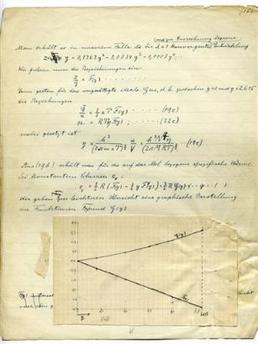
Amsterdam, Netherlands (AP, August 20) - The original manuscript of a paper Albert Einstein published in 1925 has been found in the archives of Leiden University's Lorentz Institute for Theoretical Physics, scholars said Saturday.

The handwritten manuscript titled "Quantum theory of the monatomic ideal gas" was dated December 1924. Considered one of Einstein's last great breakthroughs, it was published in the proceedings of the Prussian Academy of Sciences in Berlin in January 1925. ...

The paper predicted that at temperatures near absolute zero - around 460 degrees below zero - particles in a gas can reach a state of such low energy that they clump together in one larger "mono-atom."

The idea was developed in collaboration with Indian physicist Satyendra Nath Bose[, for who bosons were named,] and the then-theoretical state of matter was dubbed a Bose-Einstein condensation.
The existence of a Bose-Einstein condensate was demonstrated in 1995.

So what we have here is a manuscript of Einstein predicting the existence of a previously-unknown state of matter, one that existed under conditions so extreme and with properties so strange that its existence was beyond our ability to prove for 70 years. And I just think that finding that manuscript is - considering the subject, you'll pardon the expression - really cool.

RIP beep boop

Robert Moog, creator of the Moog Synthesizer, has died of cancer at the age of 71.

I remember that when "Switched on Bach" came out, most everyone loved it and was amazed at the versatility shown by the synthesizer. I, contrarian as usual, was disappointed: I thought it unfortunate that here we were, presented with something that offered the possibility of an entirely new range of musical expression, and we were to judge it by how much we could make it sound like the instruments we already had.

So as my own sort of tribute, as I write this I'm listening to "Silver Apples of the Moon." It actually wasn't done on a Moog, but it was one of the first (and, as it turned out, one of the few) pieces of electronic music meant to be heard as electronic music, not as an imitation of existing instruments.

This is bad

Yes, this is bad. This is very bad.

There is, I believe, very little chance of a consensus constitution appearing in Iraq any time soon. And that's my optimistic view. The differences that have existed from the very beginning, from before the beginning, still exist and I see no reason to believe that they will suddenly be resolved in the next 24 hours.

In a move worthy of Congressional GOPpers, the Iraqi parliament received a draft of the constitution literally minutes before the (extended) deadline on Monday, avoiding the political disaster of having to dissolve and conduct new elections. As the Times (UK) described it,
[t]o loud applause, [Hachem al-Hassani,] the speaker [of the parliament,] announced that the deadline had been met. Then to stunned confusion, he dismissed parliament without a vote, calling for three more days of talks between political leaders.
That is, they "met the deadline" but still gave themselves more time.

But not only is there still no agreement, there is even disagreement over what the disagreements are. One thing that most everyone does agree is an issue is federalism: the Kurds and Shiites are for it, the Sunnis are adamantly against it. They're so adamant, in fact, that it's all but impossible for me to see how they could agree to a draft that contains it. (Indeed, the feeling is so strong that Sunni negotiators could be risking their lives if they agreed.) Despite that rejection, the draft contains specific and detailed provisions for federalism; it even refers directly to "the federal system in the republic of Iraq." Under those provisions, provinces have the right to form (or to join to form) regions which have specific powers of local government - and regions have the right to combine into bigger regions. That presents the exact specter of a "super Shiite region" in the south that the Sunnis fear, as Iraq's oil fields and the associated wealth are mainly in the (Shiite-dominated) south and secondarily in the (Kurdish-dominated) north, with the (Sunni-dominated) central and western areas relatively devoid of known oil fields. Promises of "fair" distribution of that wealth by a central, likely Shiite-dominated, government do not reassure them.

Again, at least everyone seems to agree that remains a matter of contention. The role of Islam is a different matter. Some, such as
President Jalal Talabani, a Kurd, [have] insisted the Islam issue had been solved and "you will see in the constitution that it is not a problem."
That is, the role of Islam, declared "the official religion of the state" and "a basic source of legislation" in the draft text of the Constitution, is a settled matter. But, the New York Times reported,
[s]ome secular Iraqi leaders complained Tuesday that the country's nearly finished constitution lays the groundwork for the possible domination of the country by Shiite Islamic clerics,
arguing that the very phrasing that supposedly resolved the issue is one of the document's problems. They say further that the draft
appears to grant judges wide latitude to strike down legislation that may contravene the faith. To interpret such legislation, the constitution calls for the appointment of experts in Sharia, or Islamic law, to preside on the Supreme Federal Court.

The draft constitution, these secular Iraqis say, clears the way for religious authorities to adjudicate personal disputes like divorce and inheritance matters by allowing the establishment of religious courts, raising fears that a popularly elected Islamist-minded government could enact legislation and appoint judges who could turn the country into a theocracy,
with all that implies for rights, especially those of women. These people are worried that those "experts in Sharia" will inevitably be clerics, who will be in a position to block implementation of laws that they decree violate the "basic beliefs of Islam." In other words, Iraq will be Iran.

But here another point arises: There seems to be some disagreement about what the document actually says. Rather than saying laws can't violate the "basic beliefs" of Islam, the translation of the text as provided by AP says "No law can be passed that contradicts the undisputed rules of Islam" [emphasis added], considerably stricter language that would give less leeway to the guardians of Sharia on the Supreme Federal Court. Which is right? I can't read Arabic, so I certainly don't know, although I would tend to give the benefit of the doubt to those who question the provision since I can't imagine they wouldn't see the difference.

There are other issues as well:

- The Transitional Administrative Law's guarantee that the Council of Representatives (the parliament) will include a certain percentage of women has been downgraded to a "transitional guideline" inb the draft, which women fear will ultimately leave them unable to participate in the government.

- The guarantee of education has been limited to primary school (some wanted it to include secondary school).

- The draft says "the followers of every religion and sect are free in the practice of their religious rites," but specifically mentions the Husseiniya (Shiite) rites, raising the possibility that Shiite practices are being raised above others.

- Sunnis are upset about the banning of the Baath Party and the continuation of the National De-Baathification Committee and the banning of anyone covered by the committee from holding any official position in the federal or regional governments or the judiciary, a provision they see as targeting them as a community and cutting too many Sunnis out of eligibility for government posts.

- And overall, the Sunnis are just pissed at essentially being iced out of the negotiations toward the end. In fact, they're pissed about the whole business.
"I don't trust the Shiites anymore," said Mr. [Saleh] Mutlak, the Sunni leader. "Frankly, I don't trust the Americans."
Still, I expect there will be a draft ready for a vote on Thursday, just in time to beat the deadline. And I expect the draft will be rammed through; another delay would be politically costly by boosting the sense that the Sunnis are ultimately running the show.

There is another issue here. Bush's support on Iraq is already tanking, CNN reports:
Fifty-six percent of those polled [August 5-7] said they thought things were going badly for the United States in Iraq, and 43 percent said things were going well. ...

57 percent said the war has made the United States less safe from terrorism - a number that has risen dramatically in just two months when 39 percent said the U.S. homeland was less safe. ...

54 percent said they believe it was a mistake to send U.S. troops to Iraq; 44 percent said it was not a mistake.
With Bush grabbing onto the draft constitution to bolster his flagging support, calling the document "another important victory over the terrorists," the option of the collapse of the process and new parliamentary elections could be such a political disaster for the Shrub team that I can't see the US allowing it.

So the draft will be passed and the date for the nationwide referendum on the document will be set of October 15.

And then the fun could really start.
Sunni Arabs are determined to vote it down[, The Times (UK) reported].

They boycotted January's elections, but are now registering in their thousands as part of a concerted "no" campaign by local leaders, clerics and sheikhs. ...

Banners, sermons and leaflets have all exhorted people to vote against the constitution....

"There is no doubt that all the people here will say no to the constitution because nobody here trusts the Government and nobody wants the country to be divided the way the other groups want it," Mr Samaraai said. Jamal al-Shimari, a neighbour, agreed. "It's not going to be a constitution. It's a conspiracy to divide the country," he said, referring to the federal demands of the Shias and the Kurds.
If two-thirds of voters in at least three of Iraq's 18 provinces reject the Constitution, it will be voted down and a new national assembly will be elected to start the process over again. Sunnis, while only 20% of the total population, hold a majority in four provinces and a two-thirds majority in three.

At the same time, The Times points out, some elements of the insurgency, opposed to any cooperation with any government program, even to making a constitution, as long as foreign troops are in Iraq, have already announced an intention to keep people from voting on "the devil's constitution."
Three members of the Sunni Iraqi Islamic Party were killed in a square in Mosul after being caught putting up voter registration posters. A day earlier in Ramadi, Sunni leaders came under fire as they entered a mosque for a meeting on the subject.
So we could well see Sunnis fighting Sunnis, Shiites fighting Shiites, Sunnis fighting Shiites fighting Sunnis, Kurds trying to go their own way, and Shiites still holding to the notion that at the end of the day, their majority will enable them to lord it over everyone else.

This is bad. This is very bad.

Monday, August 22, 2005

As I gaze into my crystal ball, I see....

Updated Okay, this will be fast, a test of my predictive powers. We'll see how I do.

There will be a draft constitution for Iraq presented by tonight's deadline. It will represent an agreement between Shiites and Kurds with the Sunnis mostly left on the sidelines.

The issues at contention are the same ones that have been argued from the beginning: federalism, the distribution of oil wealth, and the role of Islam. I predict that on the first, a sort of ad hoc federalism will continue under which the Kurds will have a separate status. However, there will be no reference to "self-determination" (which implied the right of the Kurds to secede) and there will be no extension of federalism to Shiite areas.

As for the others, I predict the draft will punt. There will be vague references to no laws being "contrary" to Islam, which will mean as much or as little as the National Assembly chooses to make it in passing any given law. And the issue of sharing the wealth will likewise be tossed to the Assembly with some reference to distribution being "fair" or "based on need" - again phrases which can mean pretty much anything desired.

In short, the three big issues facing the negotiators - federalism, Islam, and oil wealth - will remain unresolved, put off until later. Just like they have been all along.

So much for today's edition of Criswell Predicts.

Footnote: Actually, one more prediction. The future status of Kirkuk, an issue important to the Kurds which was supposed to have been settled as part of the constitution, will also be punted.

Updated at 5:30 local time. Okay, that didn't take long!
In another dramatic last-minute standoff, Iraqi leaders late Monday put off a vote on a draft constitution, adjourning Parliament at a midnight deadline in a bid for more time to try to win over the Sunni Arab minority whose support is key to ending the insurgency.
There was a draft submitted to Parliament but it was withdrawn literally minutes before the deadline. After the decision to defer the matter yet again, Sunni negotiators said they rejected it because
the government and the committee did not abide by an agreement for consensus.

"We reject the draft constitution that was submitted because we did not have an accord on it," said Sunni delegate Nasser al-Janabi.
So there was a draft submitted (I was right) but without Sunni agreement (I was right), which was then withdrawn (which I suspect means the issues weren't punted far enough downfield, so I was wrong). I'll put myself down for a mixed success as a prognosticator. That's okay, I guess: Criswell once predicted that the force of gravity would soon no longer function.

More later, I hope.

Saturday, August 20, 2005

Jeopardy!

YESTERDAY'S QUESTION
Who is Johannes Brahms?

DOUBLE JEOPARDY!
Classical Musicians for $2000

While in Rome, Edvard Grieg formed a mutual admiration society with this Hungarian-born composer.

TOMORROW'S FINAL JEOPARDY! CATEGORY
Awards

A little more seepage through the cracks

Senator Russ Feingold (D-WI) has become the first senator to call for a specific deadline for pulling US troops out of Iraq. What's more, he,
criticized fellow Democrats for being too "timid" in challenging the Bush administration's war policy.
Feingold's proposed date, December 31, 2006 is much too far in the future - the deadline should be more like 90 or 120 days, not over 16 months - but the very fact that he proposed a deadline is a new crack in the Congressional ranks and says that the effects of public pressure and public dissatisfaction are starting to show.

The trial balloons the Shrub team put up about the possibility of a "significant drawdown" next year didn't seem to have the desired effect of placating the restless natives, probably because, trapped by their own rhetoric and assumptions, they couldn't commit to anything because it would "send the wrong signal" and "encourage the terrorists" and so on and so forth, so it seemed as empty a gesture as it in fact was. Besides, it was such an easy target that even the Dummycrats were able to hit it with darts of "Oh, yeah, spring 2006, right before the elections, uh huh, real coincidence, yup."

And, of course, what with the military declaring the Army is making plans for keeping the current level of troops in Iraq for more than four more years, it becomes hard to convince anyone that the WHS* are serious about abandoning their dreams of regional dominance. Over time the cracks now appearing can only grow and widen.

STDD/GTHO

Thanks for PastPeak for the link.

*WHS = White House Sociopaths

What the hell?

Updated Is this another step down the dark ladder?
Pittsburgh (AP, August 20) - Two women protesting the war in Iraq were taken to a hospital Saturday after police broke up an unauthorized march involving about five dozen people on a busy one-way street near an Army recruiting station.

David Meieran, who helped organize the protest, accused police of "inappropriate and excessive force."

Sgt. Clint Winkler, a supervisor on duty, told The Associated Press that one woman who would not leave was subdued with a Taser. He also confirmed that a police dog bit another woman on the leg when she refused police orders to disperse.

Both women and a man involved in the march were arrested, Winkler said.

"They were told to disperse, peacefully disperse, and failed to do so, so we started down the sidewalk - officers in front, K-9's behind us, and started pushing the crowd down the sidewalk," Winkler said. He said the march broke up after the arrests.
Tasered? Police dogs? "Unauthorized march?"

What the hell is going on here? Now, this AP report is all I've found on this, meaning I have to admit there could be more to it, but based on what's here, this was not "inappropriate and excessive force," it was criminal abuse, outrageous, and unconscionable.

For one thing, for over a year I've been warning that the use of tasers, sold on the basis that they offer an alternative to lethal force and aggressively promoted as "safe" and "harmless,"
will become routine, that they will not be seen as weapons of protection and necessity but of control and convenience.
And what do we have here but exactly that? A woman tasered for what? For "refusing to leave?" What the hell? Did she attack a cop? Did she threaten anyone? The cops themselves don't say that. It was because she "refused to leave." Obey or suffer!

Siccing a police dog on a woman for "refusing to disperse?" What the hell? What is this, Bull Connor's Birmingham? Are these cops auditioning for the next Abu Ghraib?

"Unauthorized march?" What the hell? Hey, you lamebrain twerps, you ignorant jackasses, you Constitutional cretins - marches which follow traffic rules and do not deny the use of public facilities to others come under "the right of the people peaceably to assemble" and do not need your flippin' permission! I don't give a flying damn if it was a "busy" street or a "one-way" street or any of the rest of it.

Now, again, I don't know for certain because the article doesn't have all the necessary details, but the police official did say the cops "started pushing the crowd down the sidewalk" - down, not onto - which seems to me a pretty damned good hint that the march was on the sidewalk, not in the street, and so was not blocking traffic.

Municipalities can impose "reasonable time and place restrictions" on demonstrations without running afoul of the Constitution - but the purpose of that authority is to insure that others are not unreasonably denied access to public facilities (including sidewalks). It is not a means for them to make blanket demands for permits for any and all public gatherings; otherwise they could insist that even a single protestor or a single person handing out leaflets could be required to get official permission before acting. It is to regulate access to be fair to all - and therefore any assembly which does not hinder the ability of others to use that public facility should not need any "authorization."

But Pittsburgh, it seems, has a history of trying to use administrative claims to limit, control, and even prevent public protest. Apparently when that doesn't work, officials are prepared to turn violent. They should all be in the dock. Scum.

Updated to note that thanks to Tim and Harry in comments, there is some more information about what happened; check there for the links. It seems that, interestingly enough, the march did go into the street and when it moved up onto the sidewalk at the recruiting station, it did pretty well block the sidewalk - but all that occurred with "limited police interference." The trouble started when a Fox cameraman got his equipment into the face of one protester and when they objected, a "minor confrontation" developed which lead to the cameraman "screaming" at the cops to arrest the protestor - at which point, hell broke loose with cops chasing protestors, hitting them, and using other such routine crowd control tools as pepper spray, tasers, and police dogs. One video at the site clearly shows a cop walking up to a woman already held on the ground and tasering her. It also develops that the woman who was bit was bit on the back of the leg; i.e., she was moving away from police when it happened.

One sidebar is that it seems a number of the protestors were wearing masks, something supposedly done, at least according to some at other actions, to express solidarity with Palestinian militants but which in my opinion is merely a pointless affectation. Based on reports at the link, however, it seems that police focused their assault on precisely those members of the group. Which suggests to me that the cops were afraid of them, saw them as threatening (or, perhaps more precisely, as more threatening than the others). The old line about how "paranoia strikes deep" works both ways.

Be that as it may, none of this additional information has altered my opinion: scum.

Update to the update: As of Sunday evening, all those arrested had been released in good health.

Friday, August 19, 2005

Jeopardy!

Jeopardy! for Wednesday
YESTERDAY'S QUESTION
What is Pluto?

JEOPARDY!
The Planets for $1000

As seen from Earth, the Moon is the brightest object in the nighttime sky; this planet is second brightest.

==

Jeopardy! for Thursday
YESTERDAY'S QUESTION
What is Venus?

DOUBLE JEOPARDY!
Classical Musicians for $400

His "Piano Sonata in C-Sharp Minor, Op. 27" is best known as the "Moonlight" Sonata.

==

Jeopardy! for Friday
YESTERDAY'S QUESTION
Who is Ludwig van Beethoven?

DOUBLE JEOPARDY!
Classical Musicians for $1200

His "German Requiem" was written to express his sorrow at the death of his mother.

Quick hit number six

Another bit of slightly old but in this case welcome news. This is from the August 9 edition of USA Today, tip via AmericaBlog:
Three years into a national debate over the security and reliability of computerized voting machines, the skeptics are winning.

In the past month, legislatures in five states - Connecticut, Hawaii, New Jersey, New York and Oregon - have passed laws requiring computer-based voting machines to produce a paper backup that can be verified by the voter, according to Electionline.org, which monitors voting systems. That brings to 25 the number of states that require a paper trail.

Fourteen other states and the District of Columbia are considering similar legislation.
Maryland was one of the first states to switch to electronic voting. Linda Lamone, the administrator of the state's Board of Elections says the experience has been good and that "if the proper security measures and procedures are put into place, it's the best system that there is." She also says the state is having studies done of the system's reliability and to see if a paper trail is needed. That's because
[s]o far, Lamone says, the debate "has been based on assumptions, and not facts. We want to know what the facts are."
In other words, Lamone is saying it's the best system there is and she doesn't need facts to know that.

The article also cites the usual whines from touchscreen lovers about how this will just cause problems and it's all so unnecessary and ultimately it comes down to "don't you trust us?"

Actually, no, we don't. And no, we shouldn't. We should never "just trust."

Quick hit number five

Under the It Can't Be All Bad News heading is found the news from the Indianapolis Star for Wednesday that
[t]The Indiana Court of Appeals today upheld the rights of parents to expose their children to Wicca, a contemporary pagan religion.
An Indianapolis couple, both practicing Wiccans, got divorced in February 2004 and have shared custody of their only son. In issuing the final divorce order, the judge ruled that the parents had to shield the boy from any exposure to their religious beliefs as well as those of any other "nonmainstream" religion. In effect, he ordered the parents to make the boy a Christian. (No, he didn't say that but the chance of somebody in central Indiana growing up any other way, even in another "mainstream" religion, in the absence of parental guidance is less than nil. I've lived there, trust me. Put it this way: The Indy Star article found it necessary to say that Wiccans "do not worship Satan.")

However, in a unanimous decision, the appeals court said the judge was out of bounds. And good for them. Apparently, despite what the Fourth Circuit Court of Appeals thinks, "freedom of religion" is not - at least not yet - limited to Judeo-Christianity.

Quick hit number four

This is a more than a week old now, but no matter how old it is, it ranks high on the outrage scale. On August 11, CBC reported that
[a] senior lawyer for the U.S. government has told a judge hearing a lawsuit over Maher Arar's deportation to Syria that foreign citizens passing through American airports have almost no rights.
Mary Mason told a hearing in Brooklyn, NY that international passengers who are merely waiting for connecting flights at US airports, who never attempt or intend to enter the US, still have to be able to prove that they could do so if they desired. If they can't, they can be seized and have no constitutional or legal rights.
Mason said the interpretation means travellers can be detained without charge, denied the right to consult a lawyer, and even refused necessities such as food and sleep.
What's more, she said, that remains true even if they are imprisoned in the US - because in the fantasy world of legalities they are still regarded as having not entered the country. The most they could expect, she maintained, was to be free of "gross physical abuse," whatever the hell that means. It can't mean torture because we don't do that, as everyone knows full well. But just in case, Department of Injustice
spokeswoman Cynthia Magnuson issued this short statement: "The United States does not practise torture, export torture or condone torture."
Of course not. Because if we do it, whatever it is, even denying people food and sleep, it's not torture.

Quick hit number three

Apparently adopting Shrub's attitude that "power means never have to say you're sorry," North Carolina Governor Mike Easley
has refused to pardon a man he sent to prison when he was a prosecutor even though the man was freed after the victims recanted their testimony.

Easley denied the petition of Sylvester Smith, 54, who was convicted in 1984 for first degree rape and two counts of first degree sexual offense, the governor's office said Wednesday. ...

A judge ordered Smith released from prison in November. The accusers, who were 5 and 6 at the time of the trial, recanted their earlier testimony and said their grandmother told them to say Smith was responsible for the abuse rather than their 9-year-old cousin. ...

Smith won a new trial and a prosecutor dismissed the charges. ...

There is no appeal of Easley's decision.
So now Smith will have to wait for a new governor whose ego is not at stake in a decision about a pardon.

By the way, redirect your anger: Easley is a Democrat.

Quick hit number two

Global warming strikes another blow, the August 20 issue of New Scientist lets us know:
The Great Lakes of the US, the planet's largest concentration of fresh water, is thawing earlier each spring, according to an analysis of ice break-ups dating back to 1846.
On 56 of the 61 lakes in Minnesota, Wisconsin, Michigan, New York and Ontario studied, the spring thaw occurred two days sooner each decade on average.
Though the thaw has been happening ever earlier since 1846, the calculations show the rate of change is now more than three times as fast as it was before 1975.
Which again confounds the "it's all natural" crowd: It seems there is no model of natural warming that could account for that acceleration of thawing over the last 30 years.

Quick hit number one

Tim over at Democratic Left Infoasis, who was kind enough to conduct (and then foolish enough to post) an email interview he did of me, has an occasional feature he calls "Whirlwind of Nausea and Hope." So with a tip of the hat to the originator, a series of "Quick Hits of Outrages and Concerns."

This one refers to Senate Majority Leader Bill Frist (R-18th century), who, apparently seeking to re-establish his bona fides with the wacko right after stumbling over stem cell research, said on Friday that so-called "intelligent design" should be taught in public schools alongside evolution. Parroting the "expose students to a wide range of ideas" meme, Frist argued that ID
"doesn't force any particular theory on anyone. I think in a pluralistic society that is the fairest way to go about education and training people for the future."
Yeah, that's the way to train people for the future: turn science into a popularity contest where you're free to believe whatever you want, facts be damned. Maybe we could go a step further and vote on scientific theories and undo the ones we don't like. I've never been too crazy about gravity, myself. Maybe I should get up a petition.

Footnote: To its credit, AP noted that "Nearly all scientists dismiss [ID] as a scientific theory, and critics say it's nothing more than religion masquerading as science."
 
// I Support The Occupy Movement : banner and script by @jeffcouturer / jeffcouturier.com (v1.2) document.write('
I support the OCCUPY movement
');function occupySwap(whichState){if(whichState==1){document.getElementById('occupyimg').src="https://sites.google.com/site/occupybanners/home/isupportoccupy-right-blue.png"}else{document.getElementById('occupyimg').src="https://sites.google.com/site/occupybanners/home/isupportoccupy-right-red.png"}} document.write('');